
About
The Artist
Alka Jiven was born and raised in Durban, South Africa. She has a degree in Architecture from the University of Cape Town that she obtained in 2020. Since then, she has worked in the architectural profession while developing her art part time. She currently lives in Cape Town, South Africa, where she creates art full time.
Alka’s identity as a woman, and as a 5th generation descendant of Indian immigrants who arrived in South Africa during British colonial rule, heavily influences her art style and themes. Having grown up around resilient and inspiring women, femininity is also a strong theme in Alka’s work.
Her artistic mediums include oil painting, ceramics, photography and most recently, sculpture.
About
The Sculptures
To observe Alka’s sculptures is to witness a material conversation between the permanent and the transient, the rigid and the fluid, the soft and hard of the feminine, a physical manifestation of her own intersectional identity as a South African Indian woman.
Although she was taught to think in terms of structural permanence, mass, and hard lines, Alka’s inspiration and experience behind space-making has been quietly informed by a much softer, more intimate structural vernacular: the sari.
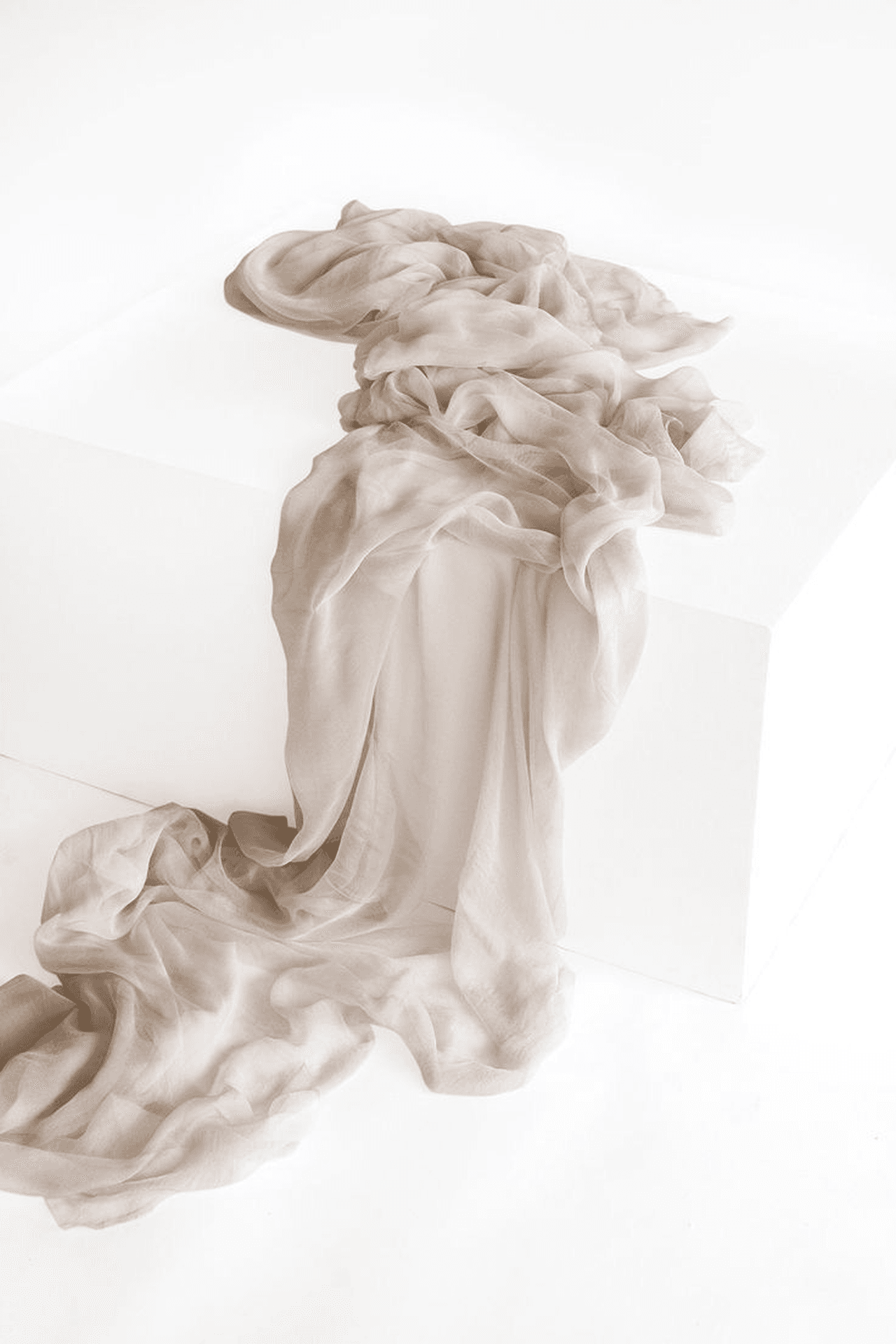
A sari is, at its core, an unstitched length of fabric, but when activated by the body, it becomes an act of spontaneous architecture. It creates volume, defines boundaries, and carves out personal space, all while emanating hundreds of years of tradition. The flowing form Alka captures in her sculptures mirrors the soft drapery of the sari, specifically evocative of the pallu (the decorative end of the fabric that sweeps over the shoulder), thus Alka explores the sari as not just a garment but as a spatial intervention.
The sculptures possess architectural gravity, redefining any space in which they are placed, commanding attention and presence. Light and shadow bounce off the folds, articulating the depth of the sculpture. Her monochromatic forms invite viewers to slow down, finding beauty in subtle undulations and quiet imperfections. By emphasizing the soft, fluid language of feminine drapery, Alka asserts that strength and structure can exist in a curve. The waves and gentle folds refuse to conform to a rigid grid, honoring the organic and adaptive nature of feminine expression.
To exist as a South African Indian woman is to exist within a complex layering of histories, traditions and cultural fabrics. This exact state of hyphenated existence is captured within the undulating folds in Alka’s sculptures. Their texture suggests something delicate and fluid mimicking a soft silken fabric flowing through time and space, a commentary of the way culture bends, folds, and adapts to a new topography, with some histories and origins having to be intentionally looked for in the shadows.
At the heart of her practice is an exploration of transformation: how something inherently rigid can be made to look soft, how fleeting gestures can become permanent, and how personal cultural narratives can be translated into a contemporary visual language. Through these works, Alka seeks to create spaces for contemplation, where material, femininity, and light exist in quiet conversation.